
“That’s not what I meant! Let me explain, that was taken out of context.”
We can have the best intentions, but sometimes our words and actions can be misinterpreted. It happens. For retailers, applying the consumer contextual value framework can be the first step in successful communication with consumers because it requires us to understand how to connect with others.
The definition of consumer contextual value
Based on the research conducted for my graduate dissertation, here’s the definition of consumer contextual value:
“Consumer contextual value is defined as a metric that can be used by brands to connect with consumers by understanding the consumer’s internal environment, which is composed of the consumer’s demographics and psychographics, and the consumer’s external environment, which is composed of the consumer’s relationship to their local/regional context, their national context, and their international context.”
– From Paris to New York: A cross-cultural comparison of department stores and their ability to deliver contextual value during a global pandemic
This is what consumer contextual value looks like in illustrated form:
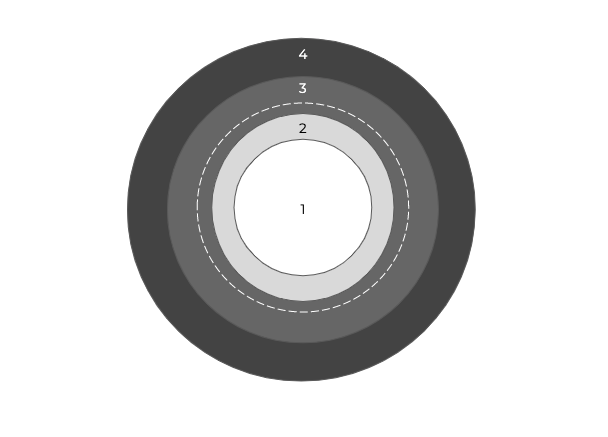
What’s the circle with the dotted line? The one that floats between the local/regional context (2) and the national context (3)? That is the position of retailers within the consumer context.
Here’s another illustrated form of the framework:
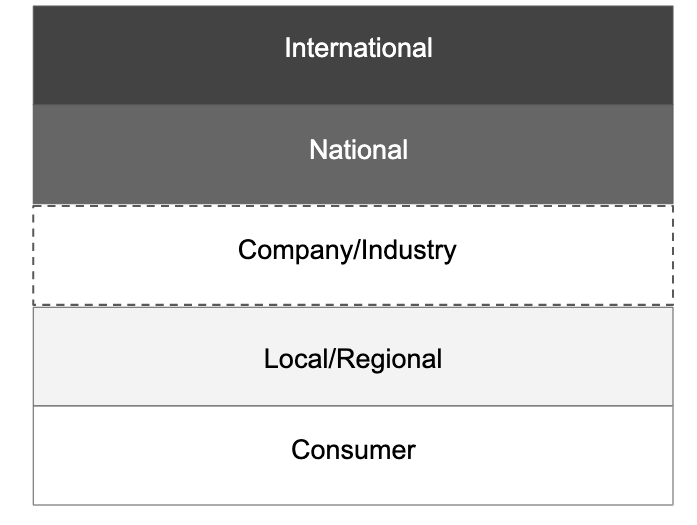
By examining the consumer’s experience across different lenses, the concept and framework force retailers to face the reality of the world, therefore grounding their sales and marketing strategies with the reality of their consumers in mind.
Personal Example: Millennial Woman
The consumer contextual value looks like a nice concept, but how do we apply it? Before introducing a case study example, I want to provide a simple example to demonstrate the dynamics between the layers of context.
01
Consumer
I am a Millennial woman. I enjoy writing, reading—fashion biographies, historical fiction, and anything set in France—and traveling. I value my relationships with my family and friends. I believe that all human beings should have access to the resources they need to maintain a safe, sustainable quality of life.
02
Local + Regional
I am a Millennial woman living in New England who spends time in Connecticut, Rhode Island, and New York City. The combination of the metropolitan pace and the coastal community is important to my identity.
03
National
I am a Millennial woman living in the United States. Despite the range of national conflicts, I remain hopeful that the United States will overcome these challenges and build a sustainable future for all Americans.
04
International
I am a Millennial American woman. Through travel, relationships, and research, globalization shapes my perspective by influencing the way I perceive my national context, my local + regional context, and my personal context.
In the personal example, notice how each context influences each other. The consumer’s context—their internal environment, their identity, their values—carries through their journey in external environments. In exchange, the external contexts exert their levels of influence on the consumer’s context, which creates a feedback loop.
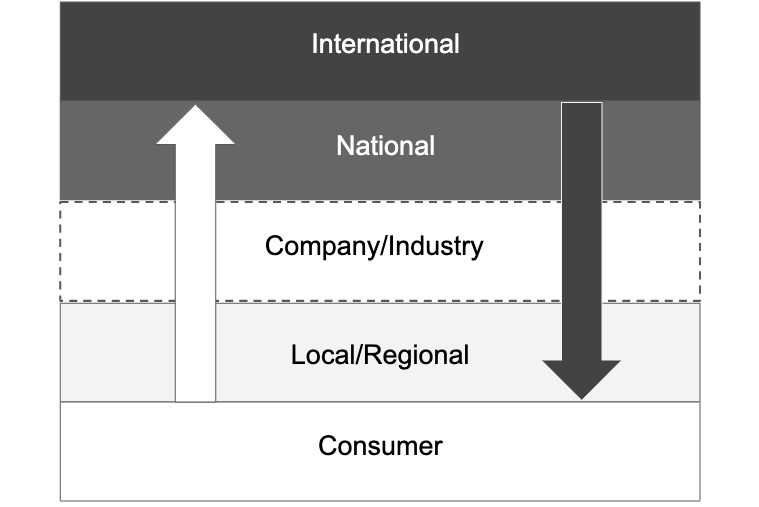
Why is it important to notice this dynamic as a retailer? The retailer is in the middle, which means that it must pay attention to the feedback loop across contexts.
Fictional Retailer Example: INDIGO + CO and racial justice
A medium-sized contemporary womenswear brand, INDIGO + CO, sells premium denim and casual tops. Based in California, INDIGO + CO proudly integrates sustainability across its supply chain. The company is working towards its B Corp certification.
The brand’s marketing messaging focuses on sustainability and style. The brand’s marketing content predominantly features caucasian, heterosexual women.
BeccA, THE CONSUMER
One of INDIGO + CO’s consumer segments is represented through a persona named Becca. Becca is a caucasian, white Millennial woman who lives in the suburbs and is an associate-level professional. After previously living in the city, Becca is looking for more casual pieces in her wardrobe as she works remote. In terms of styling needs, she wants to be able to wear these casual clothes on date nights and vacations with her friends. She rarely shops from fast-fashion brands in favor of buying higher quality, sustainable clothing. She is highly active on Instagram and Pinterest.
BLACK LIVES MATTER, THE EVENT
In late Spring 2020, there is raised awareness of the Black Lives Matter (BLM) movement across the United States.
Social media is flooded with messaging about BLM and how non-BIPOC can educate themselves about systemic privilege and how to become allies to BIPOC.
Although Becca is not a BIPOC, she is interested in learning more about how to support BLM. She learns that one way to act as an ally is to demand fashion brands to include more BIPOC in marketing campaigns and executive corporate positions. Becca researches INDIGO + CO on Google and realizes that the brand does incorporate diversity on its marketing platforms and its corporate ladder.
Becca reads emails from brands that state their solidarity with BLM. She reads INDIGO + CO’s email statement, but it does not list specific actions to address racial inequality. Regardless of the brand’s promise to support BIPOC, to Becca, the message does not seem authentic. Becca is not sure whether or not she will continue shopping with INDIGO + CO in the future.

How will INDIGO + CO proceed? It depends on their ability to understand the new dimension of their consumer’s context and whether or not they can successfully connect to Becca and their other consumers.
Conclusion
The consumer contextual value framework shows that retailers have the power to build bridges or barriers between their consumers and their external contexts:
Building a bridge allows a brand to connect with the consumer through authentic interactions and relationship building, therefore instilling a stronger sense of loyalty and increased likelihood that the consumers will become advocates.
Building a barrier, however, is problematic. A brand may try to build a wall by constructing an environment that attempts to control the consumer through the brand’s context without consideration of the consumer’s context, but it will ultimately fail because the consumer may freely leave the brand’s restrictive, constructed environment for another brand that resonates more with the consumer’s context. Instead of converting consumers into brand advocates, barriers may create brand adversaries.
– From Paris to New York: A cross-cultural comparison of department stores and their ability to deliver contextual value during a global pandemic
A global event is not the only instance where retailers can use the consumer contextual value framework:
The framework can be scaled to understand a brand’s new target market or simply use it as a monitoring tool to keep track of competitors and industry trends within national and international contexts.
[…] Companies can use the framework as a guiding tool to navigate best practices for their existing consumers as well as how to attract new consumers with an approach that balances brand integrity, authenticity, and the willingness to innovate.
– From Paris to New York: A cross-cultural comparison of department stores and their ability to deliver contextual value during a global pandemic
If you have questions or would like to request a PDF of my graduate dissertation, please send a message.

 Mia Lupo